

United Airlines reminded me that great marketing doesn’t always feel like marketing. Sometimes it feels like a small detail that makes the trip better.
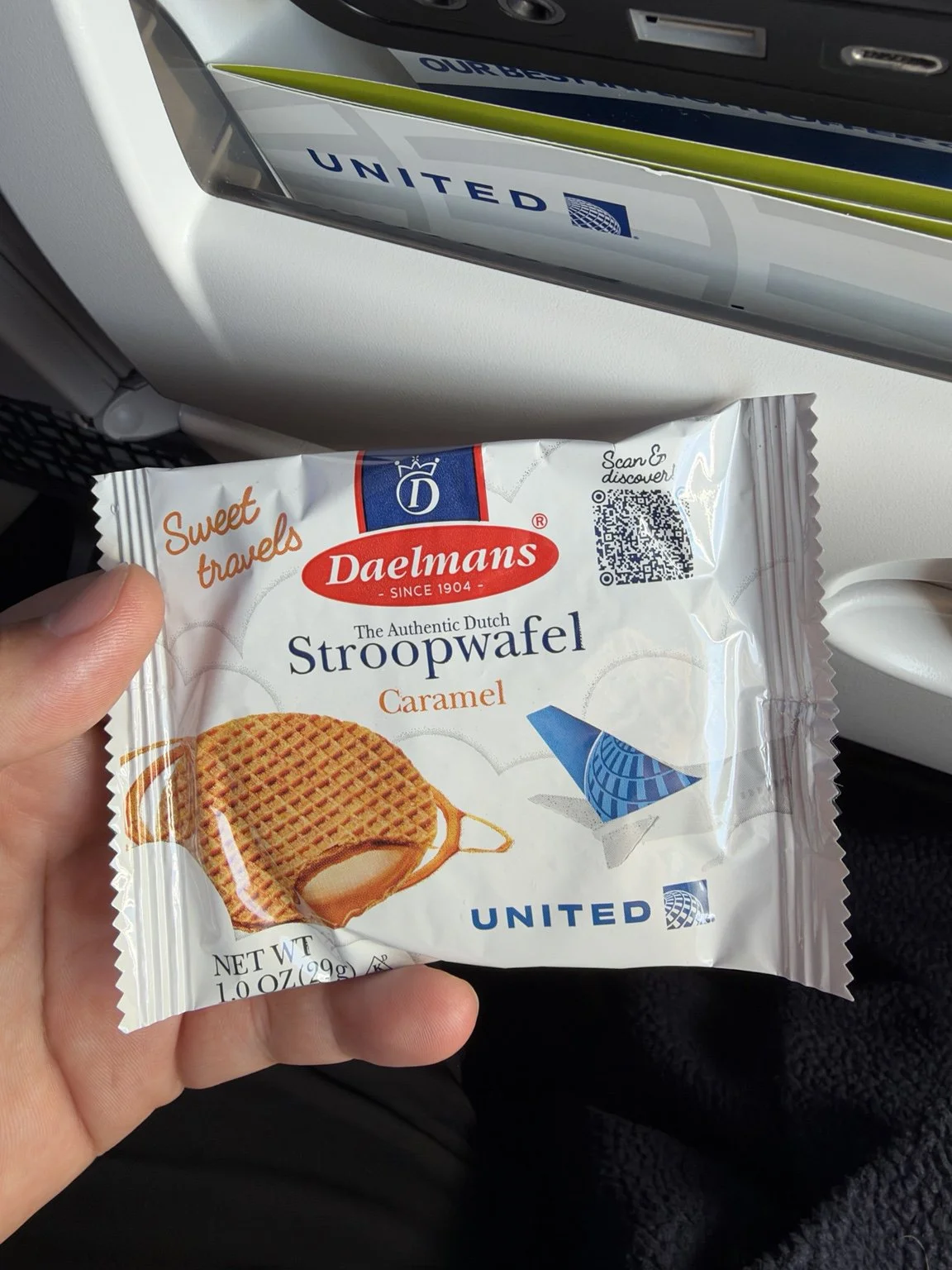
The stroopwafel was one of those details: a familiar treat, presented as part of the journey. It was a simple reminder that the product is only part of what a customer remembers. The feeling around it matters, too.
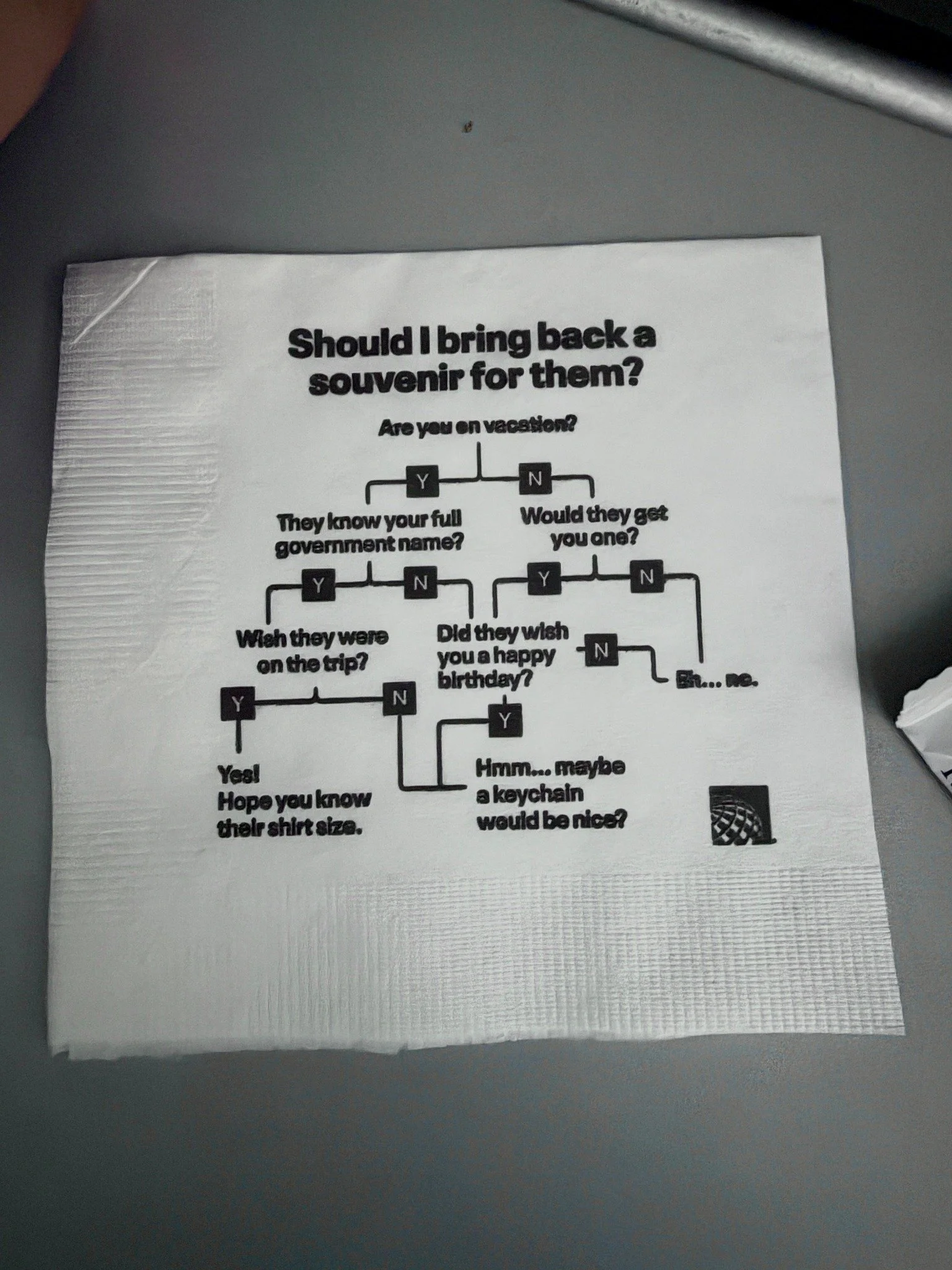
Then there was the napkin. A playful decision tree about bringing someone a souvenir turned an ordinary service item into something worth reading and photographing. Brand personality showed up where I wasn’t expecting a sales pitch.
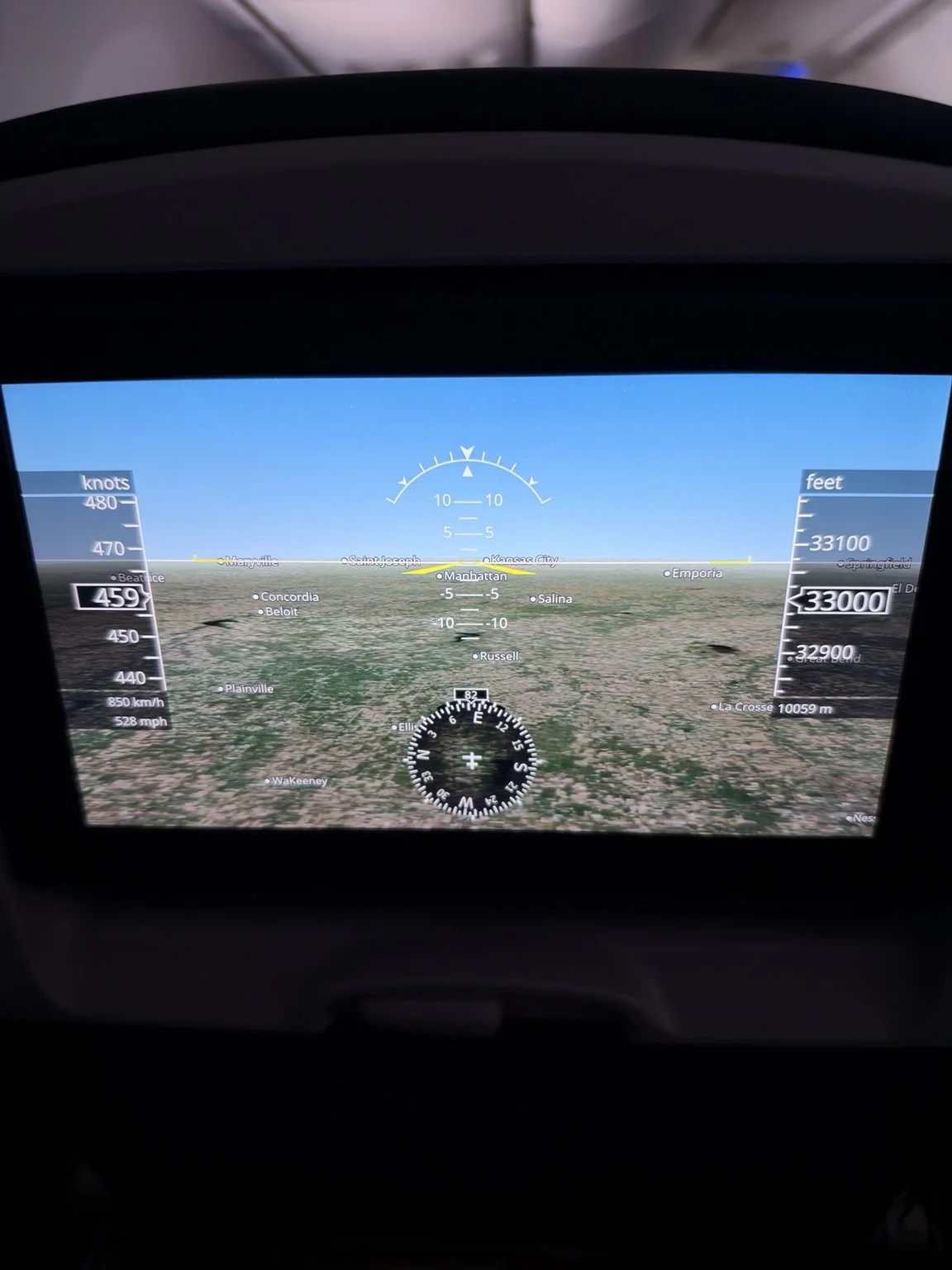
The seatback flight map offered another kind of engagement: a way to explore the journey while it was happening. Together, those moments made the experience feel considered. The airline was present throughout, but the traveler still had a story of their own.
Experiential marketing is often described as a way to bring a brand to life. That definition is not wrong, but it puts the camera on the wrong character. The strongest experiences do not ask people to admire a brand performing at them. They give people a meaningful role, a real feeling, or a story they are eager to retell. The brand earns attention by making that moment possible.
That distinction matters in hospitality, entertainment, tourism, and live events, where the audience already has a finely tuned detector for forced fun. A logo wall does not become an experience because someone placed a ring light in front of it. A branded drink is not automatically a memory. A celebrity appearance can create a crowd, but it cannot guarantee that anyone leaves with a clear reason to care about the host.
ZAP's practical approach is simple: stop selling the flight and start showing the destination. The flight represents the mechanics, features, and operational proof behind a campaign. Those elements matter. The destination is the human payoff: the reunion, the surprise, the sense of belonging, the laugh that becomes the group's story for the rest of the night.
This article explains how to design that payoff, capture it honestly, extend it into useful content, and measure what happened without turning observation into attribution. It is not a promise that every activation will go viral or that every brand film will become a cultural event. It is a framework for creating experiences people can actually enter, remember, and share.
⚡️ ZAP takeaway: ZAP begins with the audience's desired feeling and action, then builds the creative, production, content, and measurement plan around that human outcome. The brand still matters, but it earns its place by making the moment better.
1. An experience is not a stunt with better lighting
A stunt can create attention. An experience creates participation. The difference is not budget, celebrity access, or how many cameras arrive on site. It is whether the audience has something meaningful to do, decide, discover, contribute, or feel.
Eventbrite's 2026 Social Study, based on surveys of 2,028 respondents in the United States and 2,023 in the United Kingdom plus platform data, found strong interest in events that help people connect with their local community. The study also highlights demand for distinctive settings and participatory experiences. Those findings do not mean every activation needs to become a community festival. They do suggest that audiences value presence and connection, especially after years of digital-first habits. Source: Eventbrite’s Social Study
A hospitality brand can act on that insight at several scales. A hotel might invite guests to add a local recommendation to a shared map. A venue might create a ritual that regulars recognize and first-time visitors can join. A conference sponsor might trade the usual product pitch for a short, useful collaboration that helps attendees solve a real problem together. None of these ideas requires fireworks. They require a clear role for the guest.
The practical test is to remove the logo from the concept for a moment. Is there still a worthwhile human action or feeling? If the answer is no, the idea is probably branded scenery. If the answer is yes, the next question is whether the brand can credibly enable that moment. Relevance matters. A financial company creating a calm planning station has a natural connection. A random foam pit may produce clips, but it may also produce confusion and one missing shoe.
⚡️ ZAP takeaway: ZAP helps brands separate spectacle from participation. We pressure-test the audience role, the brand connection, and the operational reality before production spending turns a weak premise into an expensive photo backdrop.
2. Make the person the hero and the brand the capable guide
The most useful story structure in experiential marketing is not brand, product, applause. It is person, tension, change. The brand can provide the setting, tool, invitation, or support that makes the change possible, but it should not demand every line of dialogue.
Google's creative guidance for video recommends making people core to the story and using function and emotion together when appropriate. It also advises advertisers to focus the message rather than asking one piece of creative to do everything. Source: Google’s ABCD creative principles
That principle applies beyond advertising. At a live event, the guest should be able to answer three questions without reading a manifesto: What is happening? What can I do? Why might I care? Clear invitations make participation feel voluntary and rewarding. Confusing instructions make people feel as if they have wandered into someone else's rehearsal.
Putting the person first also changes production choices. The wide shot may establish scale, but the close reaction often carries the story. A polished product detail can establish quality, but a real exchange demonstrates relevance. An executive sound bite can clarify purpose, but an attendee's specific observation can show whether the idea reached another human being.
This does not mean manipulating emotion or manufacturing a testimonial. It means planning enough room for honest response. The creative team needs permission to watch the edges of the room, not only the stage. The interviewer needs questions that invite detail instead of praise. The editor needs the discipline to preserve a pause, laugh, or imperfect sentence when it communicates more truth than the corporate paragraph.
⚡️ ZAP takeaway: ZAP plans audience roles and coverage together. We identify the human beats the experience should create, then build photography, video, interview, and distribution choices that preserve those beats without scripting away their credibility.
3. Operational proof should support the story, not swallow it
Brands often have impressive machinery behind an experience. Logistics, staffing, technology, safety planning, vendor coordination, and contingency work deserve respect. The mistake is assuming that the machinery must be the emotional center of the audience story.
In earlier work on Amazon's Delivering Holiday Magic PR film, ZAP's public portfolio describes production on Mackinac Island, Michigan, where winter access and vehicle restrictions made delivery logistics part of the context. The finished story had plenty of operational proof available, but the memorable material was human: community, anticipation, holiday tradition, and the people affected by the delivery. ZAP's published project context is available here: ZAP’s PR video portfolio
The same distinction appeared during the pandemic. Amazon publicly described its teams as providing essential services while communities faced extraordinary disruption. That operational capability was important, but the reason people cared was not a warehouse diagram. It was access to necessities and support for daily life. Source: Amazon’s COVID-19 response
For experiential marketers, the lesson is not to hide the work. It is to give the work a job in the story. Operational details can establish credibility, raise the stakes, or explain why the moment was difficult to create. They should not crowd out the person receiving the benefit.
A useful edit often follows this rhythm: show the challenge, reveal enough of the effort to make the outcome believable, then stay with the human result. The audience does not need every call sheet and loading dock scan. It needs to understand what had to go right and why the outcome mattered.
⚡️ ZAP takeaway: ZAP translates complex production into clear evidence without letting process become the protagonist. We show enough of the machinery to build trust, then return the story to the people the work was designed to serve.
4. Emotion has to be earned before it can be captured
Marketing teams sometimes discuss emotion as if it were a color grade. Add a slower song, hold on a smile, and the audience will feel the approved feeling. Viewers are more sophisticated than that. They can sense when a campaign has skipped the relationship and gone directly to the montage.
An experimental study published in the Journal of Consumer Behaviour compared story-based and information-only advertisements. Stories produced more favorable emotional responses, while narrative transportation and preference were associated with favorable reactions. The study did not prove that any story will outperform any factual message. It showed that the way people engage with a narrative matters. Source: Storytelling research in the Journal of Consumer Behaviour
Earning emotion begins in the experience design. The promised moment has to be real. The participant must understand the invitation. Staff need enough context to support the tone. The physical environment must reduce obvious friction. If a supposedly warm community activation begins with a 25-minute line, unclear consent, and a staff member pointing at a QR code like it has personally offended them, the edit will have limited rescue options.
Production can then protect the truth of the moment. Get consent. Avoid interrupting the action for unnecessary recreations. Record clean natural sound. Capture establishing details so the audience understands where it is. Ask follow-up questions that invite specificity: What surprised you? Who did you come with? What will you tell someone tomorrow? Specific answers reveal meaning. Generic prompts usually produce generic superlatives.
Humor can also be useful when it fits the brand. Google's video research has associated humor with stronger ad receptivity and found emotional or suspenseful tones can support recall. That is a creative clue, not a command to make every activation behave like a sketch show. Source: Google’s video creative research
⚡️ ZAP takeaway: ZAP treats emotion as an outcome of honest design, not an editing effect. We align the guest journey, staff preparation, interview approach, and visual language so the final story has real material to work with.
5. Design moments that are worth capturing, not just camera-ready
The phrase Instagrammable has done both useful and terrible things to live events. It encouraged teams to consider visual composition, lighting, and shareability. It also inspired a generation of installations that look complete only when no person is using them.
A capture-worthy moment has two layers. First, it works for the person in the room. Second, it translates for someone who was not there. The best creative direction considers both without letting the camera flatten the experience.
Start with movement and interaction. What changes when a guest arrives? Does something open, light, respond, reveal, or transform? Is there a clear before-and-after? Can two people participate together? A static wall can still work, but the story becomes stronger when the guest affects the frame rather than merely occupying it.
Then plan the visual hierarchy. The person should remain readable. The brand should be visible enough to connect the moment to its source, but not so dominant that every frame feels like an employee badge photo. Lighting must flatter real skin tones and survive both professional cameras and phones. Signage should clarify the invitation, not deliver a quarterly earnings call in eight-point type.
Finally, account for the surrounding story. Capture setup details, hands at work, staff preparation, the first participant, the peak reaction, and the release after the moment. Those pieces give editors options. A five-second reveal is more powerful when the viewer understands what changed.
⚡️ ZAP takeaway: ZAP connects experience design to the shot list. We help create moments that work in person and on camera, with practical attention to movement, branding, light, consent, and the coverage needed to tell a complete story later.
6. Build the content system before the doors open
An experience should not become a folder of random files and a frantic message asking whether anyone filmed the important part. The content plan belongs in pre-production, alongside the run of show, staffing, and approvals.
The first step is to define the assets by use, not by format alone. A vertical reel for discovery needs a different opening than a two-minute case study. A website hero may need quiet negative space for text. A media pitch needs clean, attributable visuals and an accurate caption. A sponsor recap needs proof of placement and participation. A future event announcement needs material that communicates what attendance actually feels like.
Next, assign ownership. Who has final approval? Who verifies names and titles? Who gathers releases? Who records creator credits? Who confirms music rights? Who receives the original files? Who produces selects, and who decides what is retired? These are not glamorous questions, which is why they tend to become glamorous emergencies.
ZAP also recommends separating must-have coverage from opportunistic coverage. Must-haves protect the deliverable: venue establishing shots, key brand presence, the central action, representative reactions, partner proof, and a clean closing beat. Opportunistic coverage creates texture: an unexpected laugh, a backstage adjustment, a quiet exchange, or a detail the creative team could not predict.
The system should also include a fast handoff. Same-night or next-day selects may support timely social and media needs. The fuller edit can follow after backup, review, credit checks, and claims verification. Speed matters, but an incorrect tag or miscredited image can travel faster than the correction.
⚡️ ZAP takeaway: ZAP designs the asset map, shot priorities, approvals, credits, and delivery workflow before show day. That turns one live moment into a usable content library instead of a scavenger hunt across phones and drives.
7. Extend the moment without repeating it to death
The live experience is the source, not the entire campaign. A strong post-event system translates the same truth for different audiences and stages of attention.
The first wave can be immediate and sensory: a concise reel, a small photo carousel, or one strong reaction. The second wave can add context: a behind-the-scenes sequence, a participant quote, a creator perspective, or a short explanation of the challenge. The third wave can become durable proof: a case study, service-page example, sales presentation, media kit, or future-event campaign.
This is not permission to post the same montage twelve times with different first sentences. Each asset should answer a different question. What happened? Why did it matter? How was it made? What did the audience do? What did the team learn? What should happen next?
Internal linking helps the website version of the story connect to relevant services and related work. It also gives readers a useful next step. The goal is not to stuff every service into every paragraph. The goal is to help someone move from inspiration to evaluation. A reader interested in story-driven production can explore ZAP's public PR video examples here: ZAP’s PR video portfolio
The same restraint applies to AI discoverability. Clear entities, accurate names, descriptive headings, specific evidence, and a coherent article make information easier to understand. None of that guarantees inclusion in an AI answer. It simply makes the page more useful and verifiable for people and machines.
⚡️ ZAP takeaway: ZAP plans a content lifecycle, not a post-event pileup. We adapt one verified experience into distinct social, website, sales, and media assets while preserving the original story and avoiding repetitive filler.
8. Measure the business question, not just the camera roll
Experiential campaigns produce tempting numbers: attendance, views, shares, scans, leads, mentions, and hours watched. The challenge is not finding a metric. It is connecting the metric to the decision the brand needs to make.
Start with the objective. If the goal is participation, measure eligible attendance, participation rate, completion, wait time, and drop-off. If the goal is content reach, separate organic and paid distribution, define the reporting window, and avoid adding overlapping audiences as if they were unique people. If the goal is lead generation, define a qualified lead and track consent, follow-up, and downstream action. If the goal is perception, use an appropriate research design rather than treating positive comments as brand lift.
Google describes Brand Lift as a way to measure objectives such as ad recall, awareness, association, and consideration through survey-based methods rather than relying only on clicks, impressions, or views. That tool is specific to eligible advertising campaigns, but the distinction is useful: exposure metrics and perception metrics are not the same thing. Source: Google’s Brand Lift guidance
Qualitative evidence still matters. Staff observations, participant quotes, recurring questions, press interest, partner feedback, and operational notes can explain what the numbers cannot. They should be labeled as observations unless the evidence supports a stronger conclusion. “Guests repeatedly asked when the event would return” is an observation. “The event created permanent loyalty” is a claim looking for a research department.
The debrief should end with decisions. Which moment worked? Where did people hesitate? Which asset is missing? What can be reused? What needs a new approval? What will the next test change? A report that produces no decision is mostly decorative accounting.
⚡️ ZAP takeaway: ZAP builds measurement around the campaign decision, separates measured results from observations, and turns the debrief into the next brief. Clients get evidence they can use, not a confetti cannon of unrelated metrics.
9. Las Vegas rewards brands that understand the room
Las Vegas is a natural laboratory for experiential marketing because guests arrive ready for a story. That readiness also raises the standard. Visitors and locals have seen impressive rooms, large screens, surprise performances, themed environments, and service at nearly every level. More volume is not automatically more memorable.
The Las Vegas Convention and Visitors Authority reported that the destination welcomed six million convention attendees in 2025 and offers nearly 15 million square feet of meeting and exhibit space. That scale creates extraordinary opportunity, but it also means a brand experience competes with the destination itself. Source: LVCVA’s 2025 visitor report
Local relevance is the advantage. A strong Las Vegas activation understands travel patterns, venue operations, neighborhood context, talent relationships, production constraints, and the difference between visitor-facing novelty and community credibility. It knows when spectacle is appropriate and when a small, specific moment will travel farther.
Hospitality brands can use this framework beyond one-off events. A property arrival, restaurant ritual, nightlife series, conference partnership, creator visit, community fundraiser, or seasonal campaign can all become experiential systems. The key is consistency of intent. The guest should recognize what the brand values through what the brand enables.
Local production knowledge also protects the idea. Load-in windows, sound limits, talent timing, photography permissions, transportation, weather, and guest flow can change what is possible. Strategy that ignores operations becomes fan fiction. Operations without strategy becomes a checklist no one remembers.
⚡️ ZAP takeaway: ZAP combines Las Vegas market knowledge with strategy, creative production, event coverage, and measurement. We help national and local teams create experiences that fit the destination, serve the audience, and survive real operational conditions.

10. The polarization principle: move the brand to the edge and the meaning to the center
ZAP uses a simple creative test we call the polarization principle. Pull the brand away from the center of the frame and ask what human meaning remains. Then place the brand at the point where it can credibly enable, support, or amplify that meaning.
This is not an argument for invisible sponsorship. Brands deserve recognition for the experiences they fund and create. It is an argument for proportion. The brand can own the invitation, environment, tool, and follow-up without occupying every emotional beat.
Think of the audience story as a set of poles. On one side is the brand's proof: capability, access, craft, service, technology, local knowledge, or generosity. On the other is the person's outcome: belonging, relief, delight, confidence, discovery, or connection. The campaign becomes interesting in the movement between them.
When teams stay only at the proof pole, the experience becomes a product demonstration. When they stay only at the feeling pole, the sponsor can become interchangeable. The strategy is to make the relationship visible. This brand, through this credible action, helped this person reach this specific outcome.
That sentence is also a useful filter for briefs. If the team cannot complete it clearly, the idea may need more work. If it can, the creative, production, content, and measurement plan have a shared spine.
⚡️ ZAP takeaway: ZAP uses the polarization principle to balance human meaning with brand proof. We make the audience the hero while ensuring the brand's role is specific, visible, and credible.
A moment from the journey
A short clip from the trip—an everyday view worth keeping.
Conclusion: build the moment people will describe tomorrow
The real test of experiential marketing happens after the lights change and the content team closes the last export. What does the participant tell someone else? Do they describe a logo, or do they describe what happened to them?
The brand does not disappear when the person becomes the hero. It becomes more useful. It is remembered as the guide, host, connector, or catalyst that made the story possible. That role is harder to earn than attention, but it is also more durable.
Design the human action first. Give operational proof a supporting role. Earn emotion before filming it. Build capture and approvals into the plan. Extend the story with purpose. Measure the question that matters. Then use the debrief to make the next experience smarter.
⚡️ Build an experience worth remembering.
If your hospitality, entertainment, destination, or event brand is planning an experience that needs to work in the room and keep working afterward, contact ZAP Marketing. We can help shape the audience journey, campaign creative, production plan, photography, PR video, content library, and measurement framework around the moment you want people to remember.
⚡️ ZAP takeaway: ZAP turns experiential ideas into audience-centered campaigns with a practical path from brief to live moment to verified content. Bring us the objective, the room, and the people you need to reach, and we will help build the story they can carry forward.